Technical Information
Physical Data
Appearance: Clear green liquid without solid contamination
Density, 20°C: 1.092 – 1.095 g/cm³ DIN 51 757-4
Refractive index, 20°C: 1.397 – 1.401 DIN 51 423-2
pH value: 9.3 – 9.7 ASTM D 1287
Reserve alkalinity of 5g: 11 – 14 ml ASTM D 1121
Water content: max. 50% DIN 51 777-1
Water Treatment
PACKAGING
Chemical Nature
Mixture of water and monoethylene glycol with inhibitors.
Description
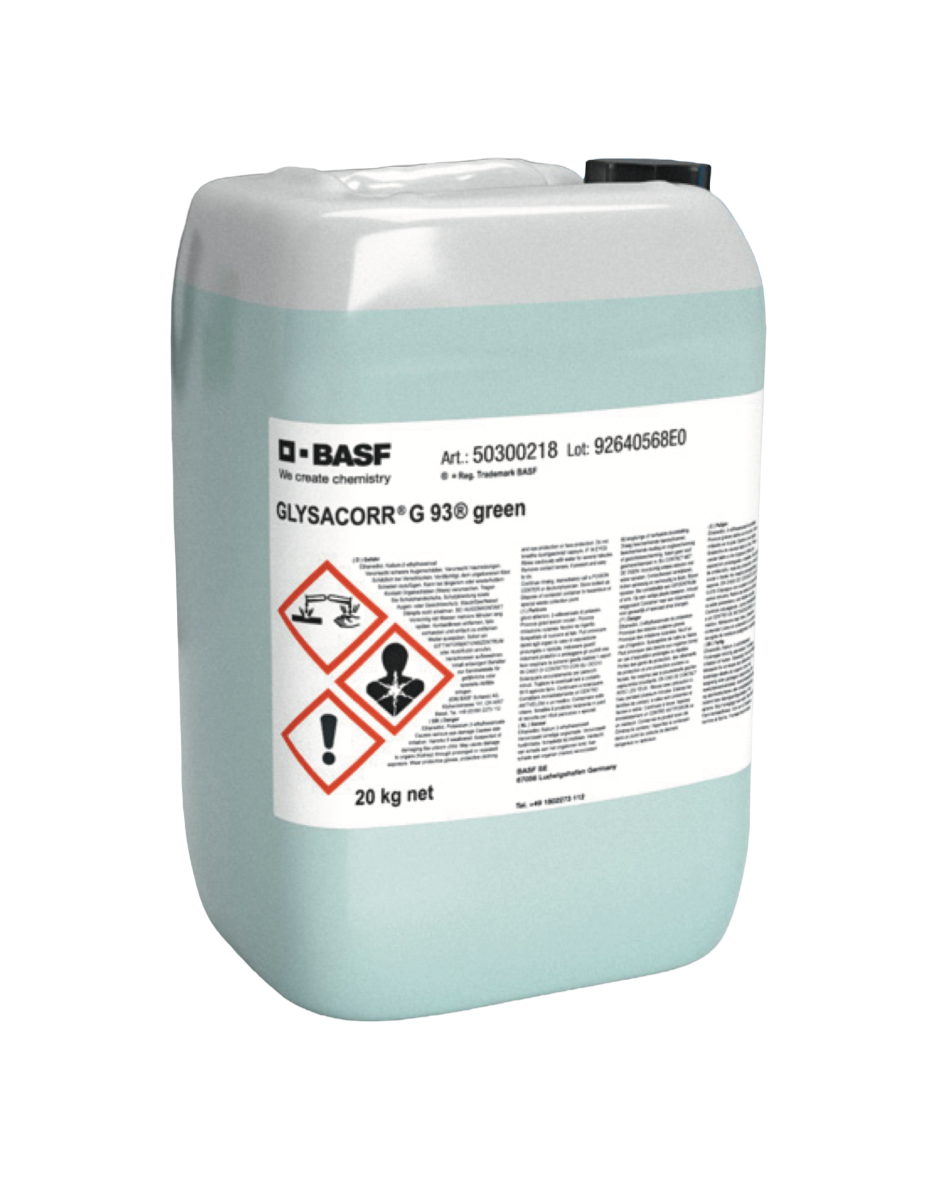
Glysacorr® G93® green is an inhibitor concentrate which is added to the cool-
ing water of internal combustion engines in cases in which the engine does
not need to be protected from freezing. Glysacorr® G93® green is phosphate-,
nitrite- and amine-free.
APPROVALS
Properties
At a concentration of 10 – 12% by volume, Glysacorr® G93® green affords excellent
protection against cavitation and corrosion to all metals and alloys that are used
in cooling systems, such as aluminum, ferrous and yellow metals. Glysacorr®
G93® green also prolongs the normal working life of water pumps. It is especially
appropriate for use in heavy-duty engines such as those used in trucks and on
ships. Glysacorr® G93® green is approved by:
ྍ Scania
ྍ MAN Energy Solutions – 28/33 & Medium Speed
ྍ MTU – MTL 504
ྍ Deutsche Bahn
ྍ Bundeswehr/German Navy
Miscibility
Glysacorr® G93® green must be diluted with water before use. It is hard water
compatible and can be mixed with tap water* before use to give solutions in the
concentration of 10 % by volume. *For preparation use clean, not overly hard
water. Wastewater from mining, seawater, brackish water, brine and industrial
waste-water are all unsuitable.
The analytical data of the water should not exceed the following limits:
ྍ Water hardness 0 – 20°dH (0 – 3.6 mmol/ l)
ྍ Chloride content max. 100 ppm
ྍ Sulphate content max. 100 ppm
Should the analysis of the water exceed the approval limits, then it has to be
suitably treated, for example by mixing with pure, distilled or deionized water.
Excessive chloride or sulphate levels can be corrected this way.